
The Identient Blog — Post 2 in the Series
The Trust Gap
Ask any enterprise AI system a question and you will get an answer. It will be fast, fluent, and confident. It may also be wrong — and you will have no reliable way to know.
This is the core problem facing CIOs, CISOs, and executive teams in 2026. AI has moved from experiment to infrastructure. It drafts summaries, triages alerts, scores risk, and prepares the analysis that shapes real decisions. But these systems operate on probability, not proof — predicting the most likely next word, not reasoning from verified sources.
The result is a growing trust gap. Leaders are making consequential decisions based on AI output they cannot trace, explain, or defend. And the faster these systems operate, the wider that gap becomes.
The Black Box Problem
Most AI systems today operate as black boxes. You put a question in. You get an answer out. What happens in between is opaque.
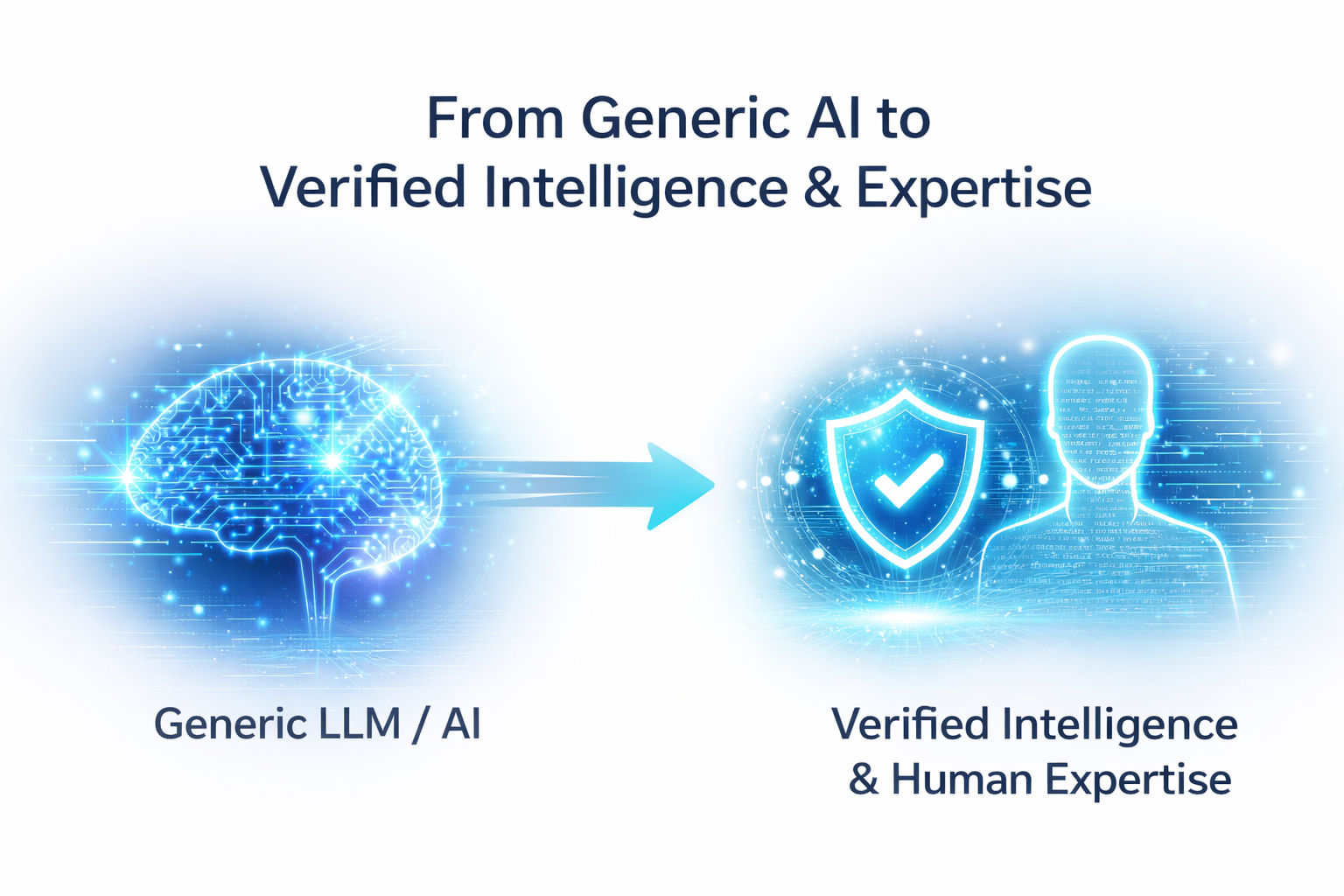
Standard large language models rely on a statistical average of the open internet. When you ask one to act as an expert, you are asking it to simulate expertise — to role-play authority based on pattern matching, not actual knowledge. There is no anchor to a specific body of work, no boundary on scope, and no way to verify where an answer came from.
For enterprise leaders, this creates three compounding risks:
- Hallucination without detection — the system generates confident answers that have no factual basis, and nothing in the output signals the error
- Scope drift — the system wanders beyond its competence into areas where its output is unreliable or dangerous
- No audit trail — when a regulator, board member, or legal team asks how a decision was reached, there is nothing to show them
These are not theoretical risks. They are operational realities — and regulators have noticed. The EU AI Act mandates transparency and traceability for high-risk AI systems. In the U.S., FINRA is pushing firms toward accountability for the data feeding AI-driven decisions, not just the models themselves. If you are accountable for the outcome, the integrity and provenance of the inputs become non-negotiable.
From AI to VI
Verified Intelligence (VI) is Identient’s answer to the black box. It represents a fundamental shift — not just in how AI is built, but in how the data behind it is governed.
VI is a data governance discipline, not just a model governance exercise. It is less about inspecting what the AI does after the fact and more about ensuring the inputs, context, and underlying data are trusted, controlled, and fit for decision-making from the start. Governance is not just oversight — it is engineering predictability and guardrails into the system before the model ever runs.
In practice, this means anchoring every response to specific, curated, human-authored knowledge instead of the open web. It means enforcing strict limits on what the system is permitted to discuss. And it means making every output traceable back to its source.
The distinction is not incremental. It is architectural. VI treats expert knowledge as strategic intellectual property — not as training data to be scraped and averaged, but as a governed asset that retains its provenance and authority.
The Four Pillars
Verified Intelligence is built on four principles that define the boundary between trusted output and black box guesswork:
- Grounding — every response is anchored to proprietary, human-authored knowledge, not the open internet
- Scope — hard limits prevent drift into areas outside the system’s verified authority
- Provenance — every insight is traceable to a specific source, with direct lineage to the original author
- Drift Awareness — continuous monitoring detects when output quality degrades or data goes stale
Together, these pillars ensure that intelligence is not just generated — it is accountable.
What This Means for Leaders
The practical impact is direct. With Verified Intelligence, leaders move from hoping AI output is accurate to knowing where it came from and what it is based on. For CISOs, this means AI-assisted analysis that can be audited and defended. For CIOs, it means output that boards and regulators can trust because the reasoning is visible. For any executive making high-stakes decisions at speed, it means the difference between confidence and exposure.
Verified Intelligence does not replace human judgment. It protects it — with better inputs, clearer accountability, and the human firmly at the center of the decision.
The Strategic Divide
Every enterprise now has access to AI. That is no longer the differentiator. And with regulators moving from guidance to enforcement, Verified Intelligence is no longer optional — it is the emerging standard for any organization using AI in consequential decisions.
What separates the next generation of market leaders is whether anyone believes what their AI says. Organizations that invest in verified expertise, transparency, and trust will not just build better technology. They will build the credibility to lead.
AI creates raw computational possibility. Verified Intelligence creates the trust required for executive action. In a world where everyone is operating through machines, that trust is the last competitive advantage that cannot be automated.
Ready to See What You’re Missing?
Experience how Identient reveals the signals behind your strategy — from real-time insight to board-level clarity.
Move beyond assumptions, align execution to what matters, and lead with confidence. Schedule a Discovery Call.
This is the second post in the Identient Blog Series. Next: Verified Digital Twins — how leaders are scaling expert judgment without surrendering accountability.