Every ungoverned agent action, model query, and identity-to-data touchpoint accrues Verification Debt — liability that compounds silently and comes due at the worst possible moment. We help you name it, measure it, and retire it.
Real experts. Real frameworks. Judgment that no longer stops at the calendar.
Cybersecurity Strategy
Expert reasoning for risk, governance, and leadership decisions.
Verified
In development
Cybersecurity Futures
Foresight frameworks for anticipating threat and identity shifts.
Verified
Pilot
Identity & Transformation
Strategic frameworks turned into everyday decision support.
Verified
Live
AI Governance & Identity
Verification Debt and agentic-identity judgment, on demand.
Verified
Live

AI Governance & Identity
Scales category-defining risk judgment

Cybersecurity strategy
Scales board-level security reasoning

Cybersecurity futures
Scales structured foresight methods

Identity & enterprise transformation
Scales operating-model frameworks
A few people in your organization see risk earlier, ask better questions, and know which assumptions are fragile. Their judgment creates disproportionate value — and their availability is finite. The organization grows. The calendar doesn’t
Expert time is fixed
Calendars cap it; prep and follow-up shrink it further.
People × decisions grow
Coverage falls
Most decisions happen without the best available perspective.
Coverage as the organization grows against a fixed calendar.
Stage 1
Answers from broad model knowledge and a prompt-defined role.
Stage 2
Answers from an approved, governed body of information.
Stage 3
A governed representation of a real expert’s knowledge, frameworks, judgment, and defined authority.
of surveyed workers say they spend too much time searching for information during the workday.
Grounding improves access.
Microsoft Work Trend Index, 2026.1
vs.
of Microsoft 365 Copilot conversations support cognitive work — analysis, evaluation, problem-solving — while only 15% primarily involve finding information.
The larger opportunity is reasoning, not retrieval.Grounding improves access.
Microsoft analysis of 100,000+ Copilot chats, 2026.2
of surveyed desk workers consider AI output completely trustworthy for work-related tasks.
Verification turns capability into confidence.
Slack Workforce Index, 2024.3
A few people in your organization see risk earlier, ask better questions, and know which assumptions are fragile. Their judgment creates disproportionate value — and their availability is finite. The organization grows. The calendar doesn’t
Conversation · recommendations · scenario analysis · decision support
Approved sources · proprietary knowledge · institutional history
Decision frameworks · heuristics · risk tolerances · tradeoff logic
Real-world identity · representative scope · escalation boundaries
Provenance · audit history · version control · drift visibility · human oversight
The expertise and decision logic that differentiate the organization, captured as an owned asset.
Who or what is represented is defined — and control over that representation is retained.
Traceability, authority boundaries, stewardship, and accountability, built in from the start.
The twin improves as approved knowledge, interactions, and outcomes accumulate.
No new destination. No new portal. Verified Digital Twins operate inside Microsoft Teams and Slack, where questions surface and decisions actually develop. Employees already spend 57% of their Microsoft 365 time in meetings, email, and chat.4
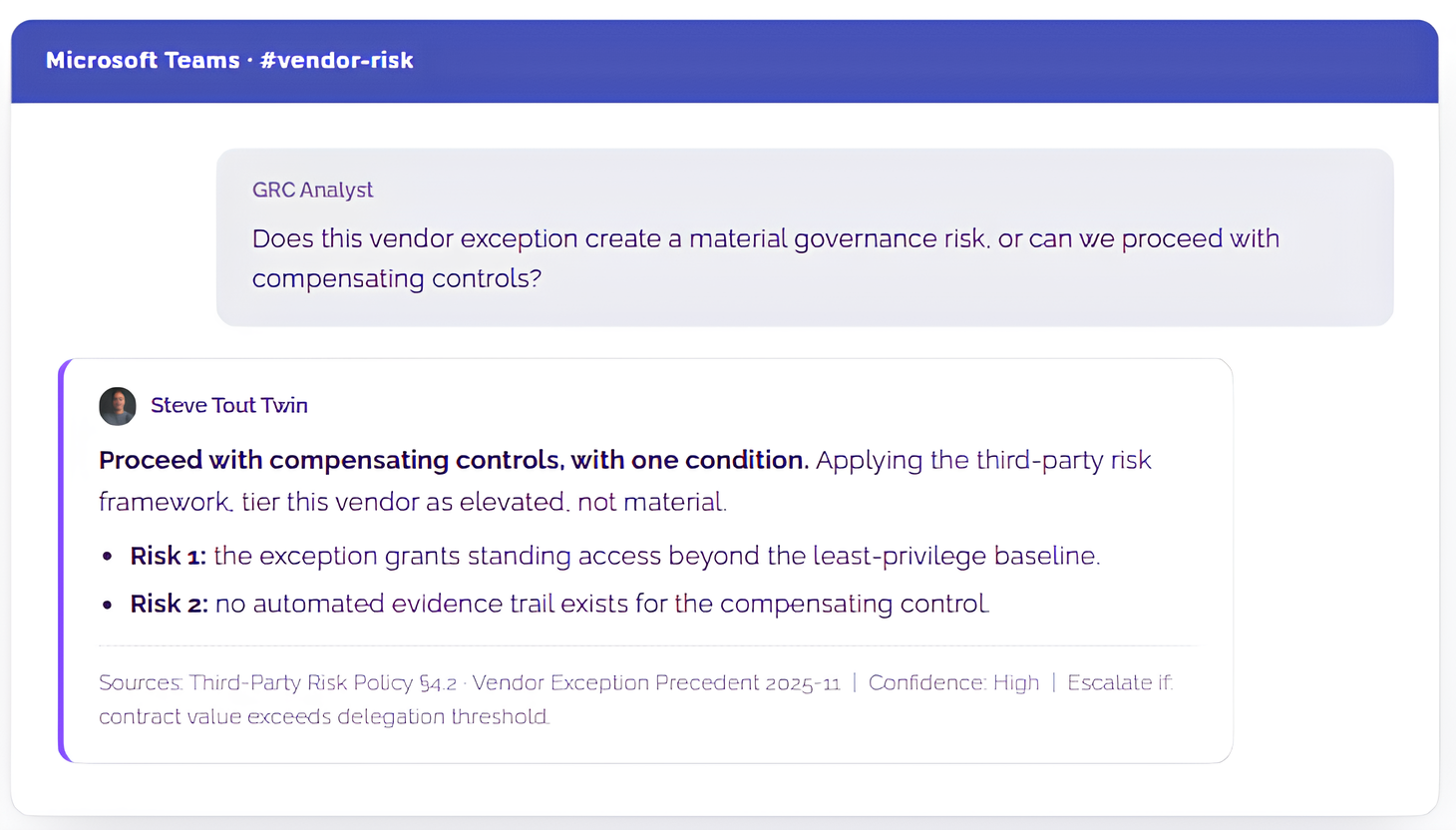
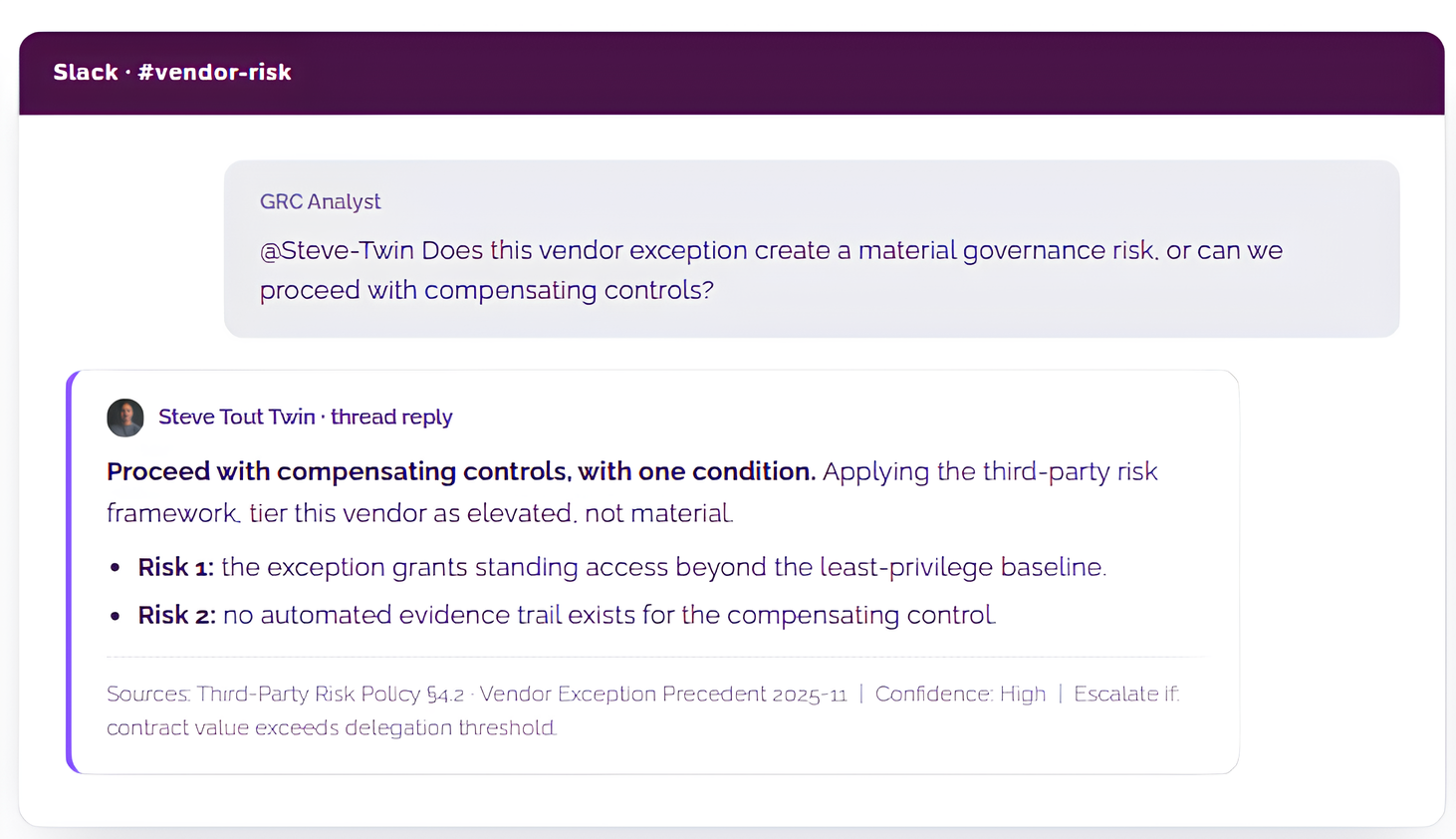
Direct message
Channel mention
Threaded response
Source-backed answer
Platform availability: [Slack: Live / Private beta / Available through pilot] · [Teams: Live / Deployment available / Planned]
4. Microsoft, Work Trend Index 2026 : employees spend 57% of Microsoft 365 application time communicating across meetings, email, and chat.
Verified
Live
Domain
AI governance, agentic identity security, Verification Debt
Scales
The AI Operating Discipline framework and two decades of identity and risk judgment
Supports
AI risk tiering decisions, agent governance reviews, board-level risk framing
Grounded in
Published frameworks, briefings, presentations, and approved advisory material
Boundary
Advises on governance posture; formal risk acceptance remains a human decision
Verified
In development
Domain
Cybersecurity strategy and security leadership
Scales
Expert reasoning for risk, governance, and executive security decisions
Supports
Security investment tradeoffs, program prioritization, leadership communication
Grounded in
Approved books, articles, presentations, and interview transcripts
Boundary
Frames options and tradeoffs; budget and program authority stay with the leadership team
Verified
Pilot
Domain
Cybersecurity futures and strategic foresight
Scales
Structured foresight methods for anticipating threat, identity, and technology shifts
Supports
Scenario planning, emerging-risk assessment, strategy stress-testing
Grounded in
Published research, foresight frameworks, and approved presentations
Boundary
Surfaces scenarios and signals; strategic bets remain a human call
Verified
private
Domain
Identity and enterprise transformation
Scales
Strategic frameworks turned into day-to-day decision support
Supports
Operating-model decisions, identity architecture direction, transformation sequencing
Grounded in
Approved frameworks, presentations, and organizational materials
Boundary
Advises on direction and sequencing; organizational commitments remain with leadership
No new destination. No new portal. Verified Digital Twins operate inside Microsoft Teams and Slack, where questions surface and decisions actually develop. Employees already spend 57% of their Microsoft 365 time in meetings, email, and chat.4
Reduce dependence on executive availability and keep decision quality consistent through growth, succession, and change.
Establish reusable practices for knowledge ownership, provenance, access, monitoring, and lifecycle management — before ungoverned pilots set the precedent.
Bring approved guidance closer to operations and cut avoidable escalations out of the critical path.
Visible sources, defined authority, escalation boundaries, and auditability — the evidence trail regulators and boards expect.
Support onboarding, succession, and leadership development so expertise doesn’t walk out the door when people do.
Extend advisory experiences to more customers without growing expert delivery hours at the same rate.
A system that represents a real expert must be able to show what it represents, where its answers came from, what it is permitted to do, and when its knowledge may no longer be reliable.
Anchored to a real entity, approved knowledge, and an actual decision context.
Explicit limits on what the twin may and may not represent.
Traceable sources behind its knowledge, perspective, and responses.
Visibility into staleness, uncertainty, confidence, and changing context.
Identify the expert bottleneck, the decision gap, the business value, and the available sources.
Define the twin’s purpose, identity, authority boundaries, source model, governance, and success measures.
Place the twin where work already happens — connected to approved knowledge and collaboration channels.
Measure usage, decisions supported, expert time returned, and drift — then expand what works.
Your first twin should solve a consequential problem, improve measurable decision coverage, and establish a trusted operating pattern for the AI capabilities that follow.