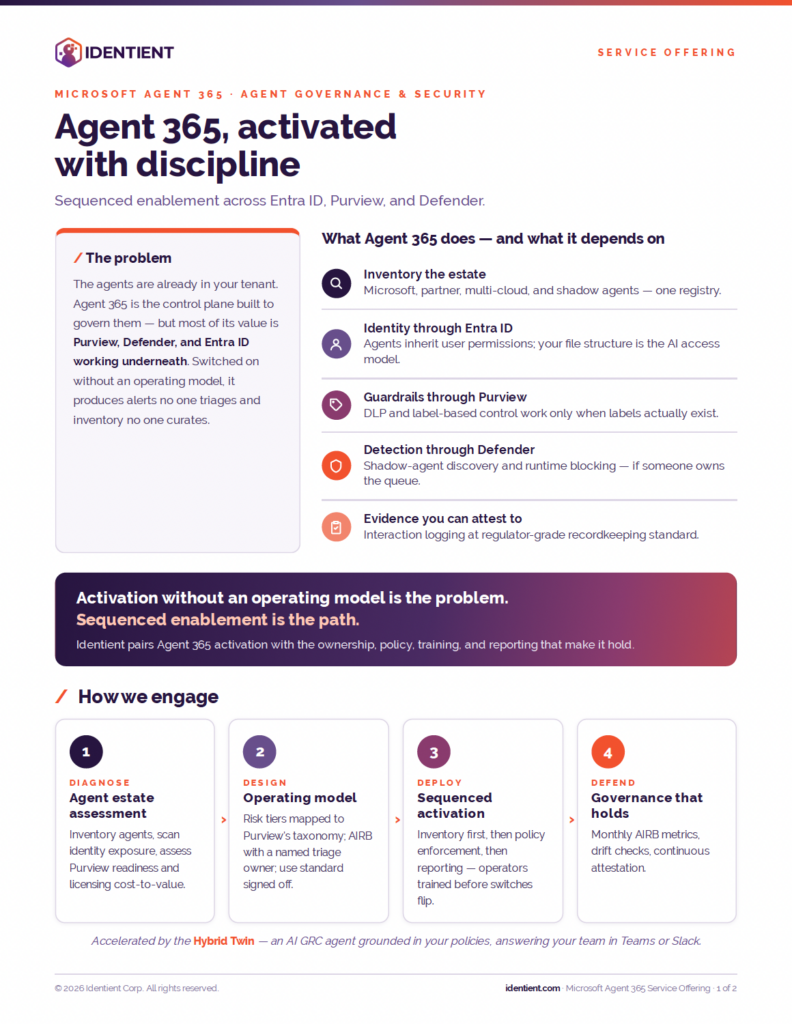
Govern the agents already in your tenant — sequenced enablement across Entra ID, Purview, and Defender, with the operating model that makes the control plane hold.
The core problem is simple: Agent 365 is easy to switch on, and switching it on is not governance. Microsoft’s control plane observes, governs, and secures the agents already running in your environment — but most of its value is Purview, Defender, and Entra ID doing the work underneath. Activated without an operating model, it produces alerts no one triages and inventory no one curates, while every ungoverned agent action keeps compounding Verification Debt. Agents inherit user permissions. DLP only enforces labels that already exist. Detection only reduces risk when someone owns the queue. The tool is right; the sequence is what most rollouts get wrong.
This two-page brief lays out the shape of the offering: what Agent 365 covers and what each capability quietly depends on, and how the work runs across four phases — Diagnose the agent estate, identity exposure, and licensing cost-to-value; Design the operating model, risk tiers, and named ownership; Deploy in sequence, with operators trained before switches flip; Defend with AIRB metrics, drift checks, and continuous attestation. It shows where engagements actually spend their time — identity foundations in Entra ID, classification taken from paper into operation in Purview, Defender findings wired to an owner — and how to begin: a four-to-six-week Diagnose, sized to your agent footprint. Activation without an operating model is the problem. Sequenced enablement is the path.