
I started Identient in 2024 as a traditional consulting company. It didn’t take long to see that AI had rewired customer expectations — outcomes over advisory cycles, accelerators over workshops, results over polished slide decks. The premium once tied to time and effort was collapsing fast.
So I started productizing expertise instead of billing it by the hour.
That is when I found the deeper problem.
Most organizations were not failing at AI because the technology was bad. They were failing because their own knowledge was scattered everywhere and trusted nowhere. Corporate amnesia was real. Data sat in silos. Context lived in inboxes, decks, Slack threads, and the heads of a few key people.
I saw the same pattern in different shapes:
- A CISO burning out in an unwinnable game, with more tools than executive presence.
- A field CTO who was the bottleneck for every meaningful deal.
- A startup CEO who could not scale past founder-led sales.
- A customer success team missing the context to save renewals and lift CSAT.
The expertise existed. It just could not reach the right person at the right moment.
There had to be a better way.
A Catalyst Hidden in Books and Podcasts
The breakthrough came from my podcast. I co-host Candid CISO, and after Season 1 we had twelve unfiltered conversations with security leaders sitting in the archive. Real expertise. Real experience. Most of it slowly being forgotten.
So I trained an AI on the full transcripts and built a chatbot in Slack.
When my co-host asked it, “How do I justify budget for AI governance?” the answer pulled together perspectives from all twelve guests — board pressure on AI, the CISO shift from rearview reporting to forward orchestration, outcomes a CFO can underwrite. Every point cited the guest and the episode it came from.
I asked ChatGPT the same question. The answer sounded fine. It also could have come from anyone, anywhere, with no source and no accountability.
If you cannot trace an answer back to a verified expert, you do not have intelligence. You have a guess that sounds smart.
One was generic and confident. The other was grounded and traceable. The difference was attribution.
If you cannot trace an answer back to a verified expert, you do not have intelligence. You have a guess that sounds smart.
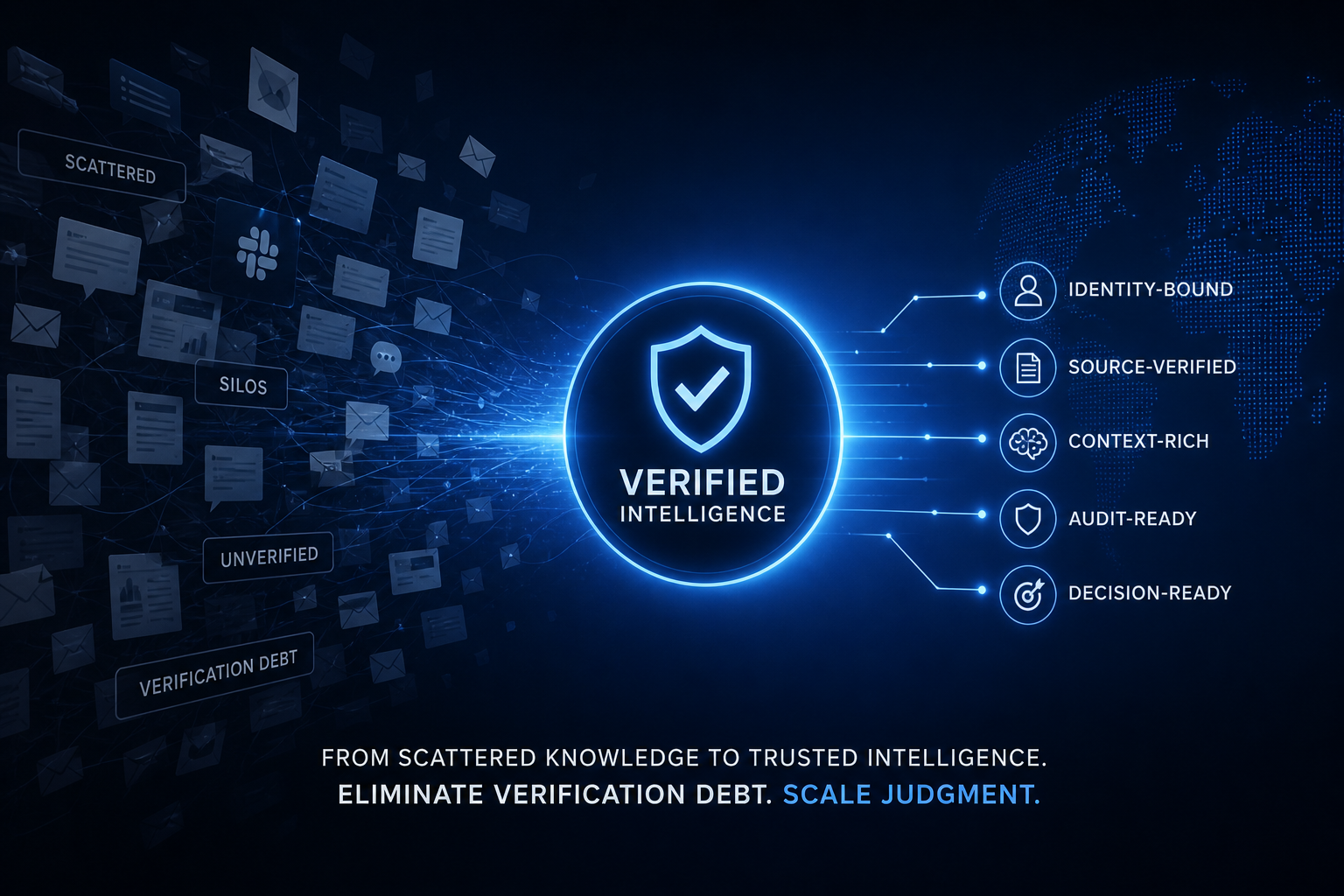
That was the seed of Verified Intelligence.
Beyond Artificial Intelligence
Today’s AI is powerful but artificial. It predicts the next word. It does not understand. It hallucinates with confidence and no accountability.
The industry keeps chasing AGI, hoping intelligence will fix itself. It won’t. What we have are stochastic engines that need real guardrails.
The next chapter is not Artificial Intelligence. It is Verified Intelligence.
Verification debt is piling up everywhere. AI generates answers faster than anyone can check them. Decisions get made on outputs no one can trace. Risk grows quietly while leaders cheer productivity gains. Like any debt, it eventually comes due.
Digital Twins Change Everything
A Digital Twin captures a leader’s expertise, judgment, and decision logic in a way that can be governed and reused. Not a chatbot pretending to be a human. A trusted, identity-bound version of how a real expert thinks.
This changes the game in every industry and every function.
The shift is simple to picture. The best thinking in your company is locked inside a few people today. Tomorrow, it isn’t. The CISO’s judgment is available to the team at 11pm during an incident. The field CTO’s intuition shows up in the deal review without the field CTO in the room. The founder’s pattern recognition sits next to the new hire on day one.
With a Digital Twin, organizations get:
- Faster alignment. Teams stop waiting on the calendar of one person.
- Preserved institutional knowledge. Wisdom does not leave when people do.
- Scalable expertise. One expert’s judgment reaches the whole company.
- Audit-ready intelligence. Every output has a source, a rationale, and a record.
Digital Twins augment your team. They do not replace it. The goal is not to fire your best people. It is to multiply their reach.
AI Is Cheap. Trust Is Expensive.
AI is cheaper than ever. Capability is abundant. Intelligence is not the bottleneck. Hype is free.
Trust is not.
Trust takes years to build and seconds to lose. When AI makes a bad call inside your business, the real cost is not the API bill. It is the regulator, the board member, the customer, or the lawyer asking, “How did you decide that?”
That question will be asked more often, not less. The organizations that can answer it cleanly — with sources, attribution, and a clear chain of judgment — will look very different from the ones that cannot.
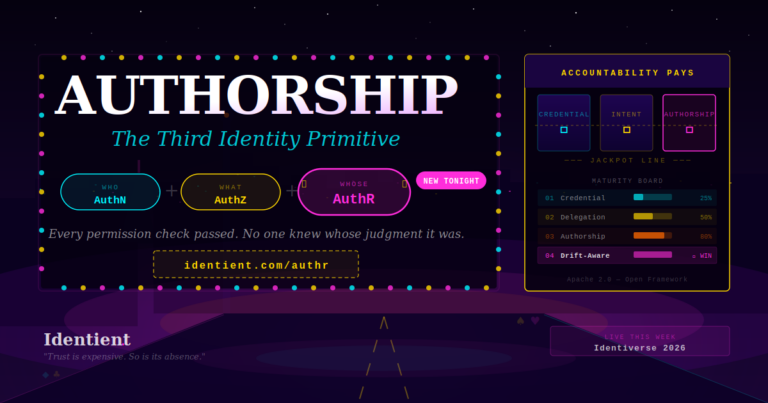
Identient exists to build the trust layer for enterprise intelligence. It is the platform Verified Digital Twins run on, and the foundation for an era already arriving — one where intelligence is verified, judgment is governed, and trust is something you can point to.
This post is part of the 5-part Identient Blog Series on leadership, trust, and AI in the agentic era. Start at the beginning with Leadership In The Age of Agentic AI — where I unpack what it takes to lead confidently when AI begins acting on your behalf.